 Add to Chrome
 Add to Firefox
 Add to Edge
Air-Know: Arbiter-Calibrated Knowledge-Internalizing Robust Network for Composed Image Retrieval
Apr 22, 2026
Composed Image Retrieval (CIR) has attracted significant attention due to its flexible multimodal query method, yet its development is severely constrained by the Noisy Triplet Correspondence (NTC) problem. Most existing robust learning methods rely on the "small loss hypothesis", but the unique semantic ambiguity in NTC, such as "partial matching", invalidates this assumption, leading to unreliable noise identification. This entraps the model in a self dependent vicious cycle where the learner is intertwined with the arbiter, ultimately causing catastrophic "representation pollution". To address this critical challenge, we propose a novel "Expert-Proxy-Diversion" decoupling paradigm, named Air-Know (ArbIteR calibrated Knowledge iNternalizing rObust netWork). Air-Know incorporates three core modules: (1) External Prior Arbitration (EPA), which utilizes Multimodal Large Language Models (MLLMs) as an offline expert to construct a high precision anchor dataset; (2) Expert Knowledge Internalization (EKI), which efficiently guides a lightweight proxy "arbiter" to internalize the expert's discriminative logic; (3) Dual Stream Reconciliation (DSR), which leverages the EKI's matching confidence to divert the training data, achieving a clean alignment stream and a representation feedback reconciliation stream. Extensive experiments on multiple CIR benchmark datasets demonstrate that Air-Know significantly outperforms existing SOTA methods under the NTC setting, while also showing strong competitiveness in traditional CIR.

HABIT: Chrono-Synergia Robust Progressive Learning Framework for Composed Image Retrieval
Apr 20, 2026Composed Image Retrieval (CIR) is a flexible image retrieval paradigm that enables users to accurately locate the target image through a multimodal query composed of a reference image and modification text. Although this task has demonstrated promising applications in personalized search and recommendation systems, it encounters a severe challenge in practical scenarios known as the Noise Triplet Correspondence (NTC) problem. This issue primarily arises from the high cost and subjectivity involved in annotating triplet data. To address this problem, we identify two central challenges: the precise estimation of composed semantic discrepancy and the insufficient progressive adaptation to modification discrepancy. To tackle these challenges, we propose a cHrono-synergiA roBust progressIve learning framework for composed image reTrieval (HABIT), which consists of two core modules. First, the Mutual Knowledge Estimation Module quantifies sample cleanliness by calculating the Transition Rate of mutual information between the composed feature and the target image, thereby effectively identifying clean samples that align with the intended modification semantics. Second, the Dual-consistency Progressive Learning Module introduces a collaborative mechanism between the historical and current models, simulating human habit formation to retain good habits and calibrate bad habits, ultimately enabling robust learning under the presence of NTC. Extensive experiments conducted on two standard CIR datasets demonstrate that HABIT significantly outperforms most methods under various noise ratios, exhibiting superior robustness and retrieval performance. Codes are available at https://github.com/Lee-zixu/HABIT
GA-GS: Generation-Assisted Gaussian Splatting for Static Scene Reconstruction
Apr 06, 2026Reconstructing static 3D scene from monocular video with dynamic objects is important for numerous applications such as virtual reality and autonomous driving. Current approaches typically rely on background for static scene reconstruction, limiting the ability to recover regions occluded by dynamic objects. In this paper, we propose GA-GS, a Generation-Assisted Gaussian Splatting method for Static Scene Reconstruction. The key innovation of our work lies in leveraging generation to assist in reconstructing occluded regions. We employ a motion-aware module to segment and remove dynamic regions, and thenuse a diffusion model to inpaint the occluded areas, providing pseudo-ground-truth supervision. To balance contributions from real background and generated region, we introduce a learnable authenticity scalar for each Gaussian primitive, which dynamically modulates opacity during splatting for authenticity-aware rendering and supervision. Since no existing dataset provides ground-truth static scene of video with dynamic objects, we construct a dataset named Trajectory-Match, using a fixed-path robot to record each scene with/without dynamic objects, enabling quantitative evaluation in reconstruction of occluded regions. Extensive experiments on both the DAVIS and our dataset show that GA-GS achieves state-of-the-art performance in static scene reconstruction, especially in challenging scenarios with large-scale, persistent occlusions.
Drift-Based Policy Optimization: Native One-Step Policy Learning for Online Robot Control
Apr 04, 2026Although multi-step generative policies achieve strong performance in robotic manipulation by modeling multimodal action distributions, they require multi-step iterative denoising at inference time. Each action therefore needs tens to hundreds of network function evaluations (NFEs), making them costly for high-frequency closed-loop control and online reinforcement learning (RL). To address this limitation, we propose a two-stage framework for native one-step generative policies that shifts refinement from inference to training. First, we introduce the Drift-Based Policy (DBP), which leverages fixed-point drifting objectives to internalize iterative refinement into the model parameters, yielding a one-step generative backbone by design while preserving multimodal action modeling capacity. Second, we develop Drift-Based Policy Optimization (DBPO), an online RL framework that equips the pretrained backbone with a compatible stochastic interface, enabling stable on-policy updates without sacrificing the one-step deployment property. Extensive experiments demonstrate the effectiveness of the proposed framework across offline imitation learning, online fine-tuning, and real-world control scenarios. DBP matches or exceeds the performance of multi-step diffusion policies while achieving up to $100\times$ faster inference. It also consistently outperforms existing one-step baselines on challenging manipulation benchmarks. Moreover, DBPO enables effective and stable policy improvement in online settings. Experiments on a real-world dual-arm robot demonstrate reliable high-frequency control at 105.2 Hz.
From Woofs to Words: Towards Intelligent Robotic Guide Dogs with Verbal Communication
Mar 13, 2026Assistive robotics is an important subarea of robotics that focuses on the well-being of people with disabilities. A robotic guide dog is an assistive quadruped robot that helps visually impaired people in obstacle avoidance and navigation. Enabling language capabilities for robotic guide dogs goes beyond naively adding an existing dialog system onto a mobile robot. The novel challenges include grounding language in the dynamically changing environment and improving spatial awareness for the human handler. To address those challenges, we develop a novel dialog system for robotic guide dogs that uses LLMs to verbalize both navigational plans and scenes. The goal is to enable verbal communication for collaborative decision-making within the handler-robot team. In experiments, we conducted a human study to evaluate different verbalization strategies and a simulation study to assess the efficiency and accuracy in navigation tasks.
M$^2$-Miner: Multi-Agent Enhanced MCTS for Mobile GUI Agent Data Mining
Feb 05, 2026Graphical User Interface (GUI) agent is pivotal to advancing intelligent human-computer interaction paradigms. Constructing powerful GUI agents necessitates the large-scale annotation of high-quality user-behavior trajectory data (i.e., intent-trajectory pairs) for training. However, manual annotation methods and current GUI agent data mining approaches typically face three critical challenges: high construction cost, poor data quality, and low data richness. To address these issues, we propose M$^2$-Miner, the first low-cost and automated mobile GUI agent data-mining framework based on Monte Carlo Tree Search (MCTS). For better data mining efficiency and quality, we present a collaborative multi-agent framework, comprising InferAgent, OrchestraAgent, and JudgeAgent for guidance, acceleration, and evaluation. To further enhance the efficiency of mining and enrich intent diversity, we design an intent recycling strategy to extract extra valuable interaction trajectories. Additionally, a progressive model-in-the-loop training strategy is introduced to improve the success rate of data mining. Extensive experiments have demonstrated that the GUI agent fine-tuned using our mined data achieves state-of-the-art performance on several commonly used mobile GUI benchmarks. Our work will be released to facilitate the community research.
ProjDevBench: Benchmarking AI Coding Agents on End-to-End Project Development
Feb 02, 2026Recent coding agents can generate complete codebases from simple prompts, yet existing evaluations focus on issue-level bug fixing and lag behind end-to-end development. We introduce ProjDevBench, an end-to-end benchmark that provides project requirements to coding agents and evaluates the resulting repositories. Combining Online Judge (OJ) testing with LLM-assisted code review, the benchmark evaluates agents on (1) system architecture design, (2) functional correctness, and (3) iterative solution refinement. We curate 20 programming problems across 8 categories, covering both concept-oriented tasks and real-world application scenarios, and evaluate six coding agents built on different LLM backends. Our evaluation reports an overall acceptance rate of 27.38%: agents handle basic functionality and data structures but struggle with complex system design, time complexity optimization, and resource management. Our benchmark is available at https://github.com/zsworld6/projdevbench.
An effective interactive brain cytoarchitectonic parcellation framework using pretrained foundation model
Jan 15, 2026Cytoarchitectonic mapping provides anatomically grounded parcellations of brain structure and forms a foundation for integrative, multi-modal neuroscience analyses. These parcellations are defined based on the shape, density, and spatial arrangement of neuronal cell bodies observed in histological imaging. Recent works have demonstrated the potential of using deep learning models toward fully automatic segmentation of cytoarchitectonic areas in large-scale datasets, but performance is mainly constrained by the scarcity of training labels and the variability of staining and imaging conditions. To address these challenges, we propose an interactive cytoarchitectonic parcellation framework that leverages the strong transferability of the DINOv3 vision transformer. Our framework combines (i) multi-layer DINOv3 feature fusion, (ii) a lightweight segmentation decoder, and (iii) real-time user-guided training from sparse scribbles. This design enables rapid human-in-the-loop refinement while maintaining high segmentation accuracy. Compared with training an nnU-Net from scratch, transfer learning with DINOv3 yields markedly improved performance. We also show that features extracted by DINOv3 exhibit clear anatomical correspondence and demonstrate the method's practical utility for brain region segmentation using sparse labels. These results highlight the potential of foundation-model-driven interactive segmentation for scalable and efficient cytoarchitectonic mapping.
PROTEA: Securing Robot Task Planning and Execution
Jan 12, 2026Robots need task planning methods to generate action sequences for complex tasks. Recent work on adversarial attacks has revealed significant vulnerabilities in existing robot task planners, especially those built on foundation models. In this paper, we aim to address these security challenges by introducing PROTEA, an LLM-as-a-Judge defense mechanism, to evaluate the security of task plans. PROTEA is developed to address the dimensionality and history challenges in plan safety assessment. We used different LLMs to implement multiple versions of PROTEA for comparison purposes. For systemic evaluations, we created a dataset containing both benign and malicious task plans, where the harmful behaviors were injected at varying levels of stealthiness. Our results provide actionable insights for robotic system practitioners seeking to enhance robustness and security of their task planning systems. Details, dataset and demos are provided: https://protea-secure.github.io/PROTEA/
IDOL: Meeting Diverse Distribution Shifts with Prior Physics for Tropical Cyclone Multi-Task Estimation
Nov 13, 2025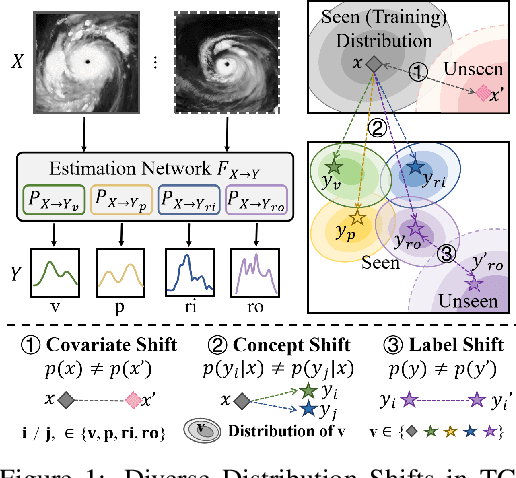
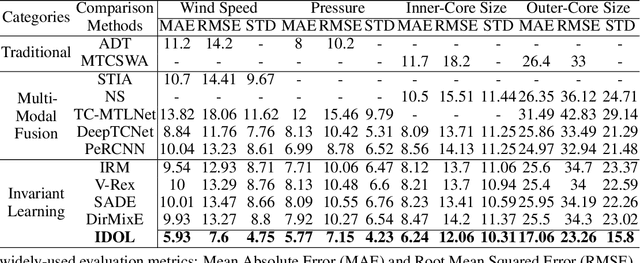
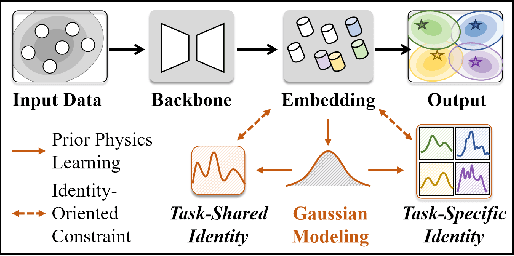

Tropical Cyclone (TC) estimation aims to accurately estimate various TC attributes in real time. However, distribution shifts arising from the complex and dynamic nature of TC environmental fields, such as varying geographical conditions and seasonal changes, present significant challenges to reliable estimation. Most existing methods rely on multi-modal fusion for feature extraction but overlook the intrinsic distribution of feature representations, leading to poor generalization under out-of-distribution (OOD) scenarios. To address this, we propose an effective Identity Distribution-Oriented Physical Invariant Learning framework (IDOL), which imposes identity-oriented constraints to regulate the feature space under the guidance of prior physical knowledge, thereby dealing distribution variability with physical invariance. Specifically, the proposed IDOL employs the wind field model and dark correlation knowledge of TC to model task-shared and task-specific identity tokens. These tokens capture task dependencies and intrinsic physical invariances of TC, enabling robust estimation of TC wind speed, pressure, inner-core, and outer-core size under distribution shifts. Extensive experiments conducted on multiple datasets and tasks demonstrate the outperformance of the proposed IDOL, verifying that imposing identity-oriented constraints based on prior physical knowledge can effectively mitigates diverse distribution shifts in TC estimation.Code is available at https://github.com/Zjut-MultimediaPlus/IDOL.